Outline
- How Artificial Intelligence Is Quietly Reshaping Everyday Life in 2026
- The Invisible AI Revolution: Why It Feels Subtle but Powerful
- AI at Home: Smarter Living Without the Sci-Fi Feel
- Voice assistants that actually understand context
- Predictive home automation
- Workplace Transformation: AI as a Silent Coworker
- Productivity tools
- Decision support systems
- Healthcare in 2026: AI Working Behind the Scenes
- Early diagnosis
- Personalized treatment
- Education Reimagined: Learning That Adapts to You
- Personalized learning paths
- AI tutors
- Transportation and Mobility: AI in Everyday Movement
- Smart navigation
- Autonomous assistance
- Shopping, Finance, and Daily Decisions Powered by AI
- Personalized shopping
- Fraud detection and budgeting
- Entertainment and Creativity: AI as a Collaborative Partner
- Content recommendations
- Creative assistance
- Ethics, Privacy, and Trust in Everyday AI
- What the Future Holds Beyond 2026
- Conclusion
- FAQs
How Artificial Intelligence Is Quietly Reshaping Everyday Life in 2026
Artificial intelligence isn’t arriving with flashing lights or dramatic announcements anymore. In 2026, it has settled into something far more powerful: normal life. AI no longer feels like a futuristic concept reserved for tech labs or science fiction movies. Instead, it’s woven into the background of our daily routines, quietly making decisions, offering suggestions, and smoothing out friction we didn’t even realize existed. From the moment you wake up to the second you fall asleep, AI is working silently alongside you.
What makes this shift fascinating is how subtle it feels. There’s no single moment where people stop and say, “AI changed my life today.” Yet over time, these small conveniences stack up. Your phone predicts what you need before you ask. Your home adjusts to your habits. Your workday flows more efficiently. In 2026, AI isn’t about replacing humans; it’s about augmenting human life in ways that feel natural, almost invisible. Let’s explore how this quiet transformation is unfolding across everyday experiences.
The Invisible AI Revolution: Why It Feels Subtle but Powerful
The AI revolution of 2026 doesn’t announce itself loudly because it doesn’t need to. Unlike earlier technological leaps, this one integrates seamlessly into existing tools and behaviors. Instead of forcing people to adapt, AI adapts to people. That’s the real breakthrough. Algorithms now learn from context, behavior, and preferences with remarkable precision, making their presence feel less like technology and more like intuition.
This invisibility is intentional. Companies design AI systems to fade into the background, reducing friction rather than creating novelty. Think of how spell check evolved into grammar suggestions that understand tone, or how maps shifted from static directions to real-time traffic predictions. These systems don’t demand attention; they earn trust by being consistently useful. The result is a form of ambient intelligence that supports daily life without overwhelming it.
Another reason AI feels quiet is its normalization. Once something works reliably, people stop noticing it. Just like electricity or the internet, AI has become infrastructure. It’s there when you need it and forgotten when you don’t. That’s not a failure of innovation; it’s the highest compliment technology can receive.
AI at Home: Smarter Living Without the Sci-Fi Feel
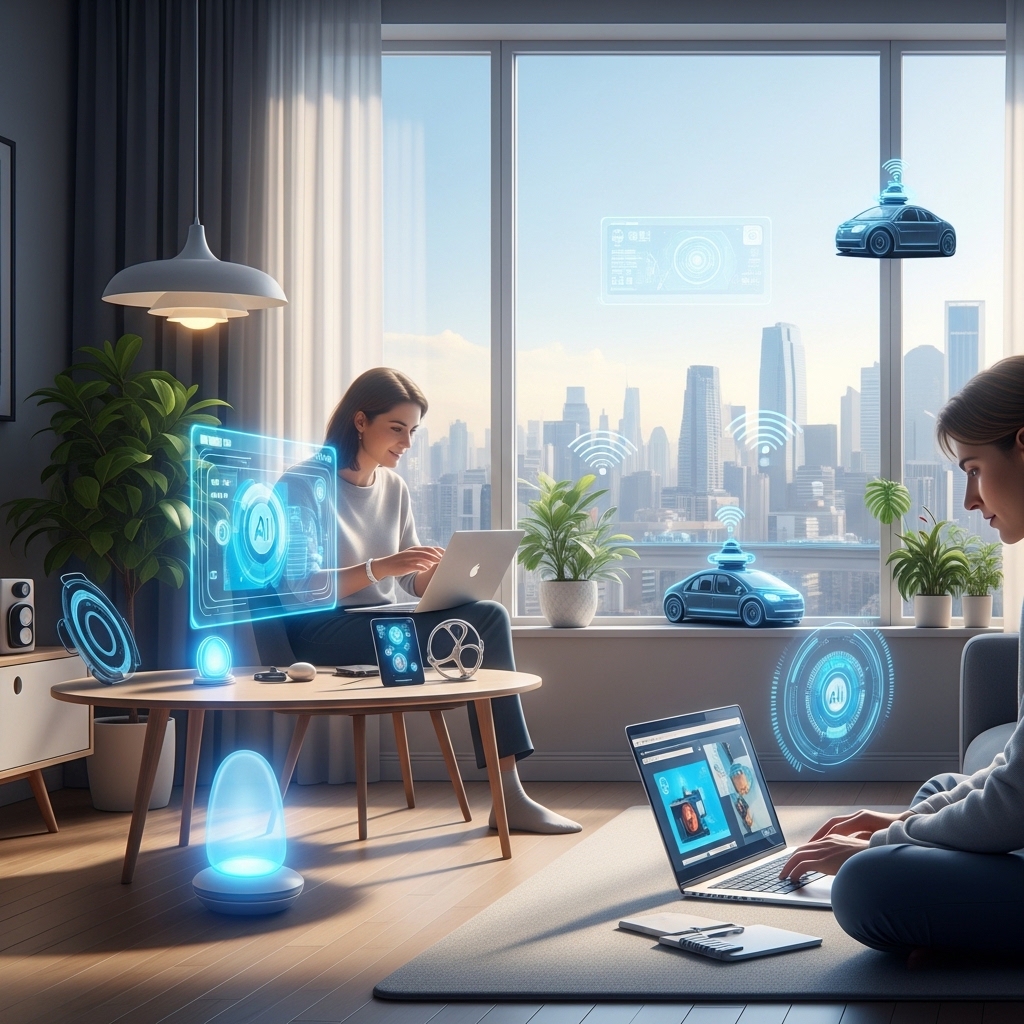
Homes in 2026 are smarter, but not in the flashy, robotic way many once imagined. Instead of talking machines everywhere, AI operates as a calm conductor behind the scenes. Voice assistants understand nuance, context, and even emotion better than ever. You don’t have to speak in commands anymore; casual conversation works just fine.
Home automation systems now learn routines organically. Lighting adjusts based on mood and time of day. Thermostats anticipate comfort rather than reacting to discomfort. Appliances run at optimal times to save energy and reduce costs. None of this feels invasive because it aligns with daily habits instead of interrupting them.
Security systems also benefit quietly. AI-powered cameras distinguish between familiar faces, strangers, and harmless motion like pets or falling leaves. Notifications are fewer but more meaningful. The home becomes a responsive environment rather than a collection of gadgets. In 2026, AI at home doesn’t try to impress you—it tries to understand you.
Workplace Transformation: AI as a Silent Coworker
At work, AI has become less of a threat and more of a teammate. In 2026, most professionals interact with AI daily without explicitly labeling it as such. Writing assistants help refine emails. Scheduling tools predict availability. Data analysis happens in seconds instead of days. These systems don’t replace human judgment; they enhance it.
AI handles repetitive cognitive tasks, freeing people to focus on strategy, creativity, and problem-solving. Meetings are summarized automatically. Action items are extracted and tracked. Even brainstorming sessions benefit from AI-generated prompts that spark new ideas. The result is less mental clutter and more meaningful work.
Perhaps the most significant change is decision support. AI models analyze vast datasets and present insights in plain language. Managers don’t just get numbers; they get explanations. This democratizes expertise and reduces reliance on intuition alone. In 2026, AI doesn’t sit at the head of the table—it quietly supports everyone around it.
Healthcare in 2026: AI Working Behind the Scenes
Healthcare may be where AI’s quiet impact matters most. In 2026, patients rarely interact directly with AI, yet its influence is profound. Diagnostic tools analyze medical images with incredible accuracy, often flagging issues before symptoms appear. Doctors use these insights to make faster, more confident decisions.
Personalized medicine has advanced significantly. AI models consider genetics, lifestyle, and medical history to recommend treatments tailored to individuals. Wearable devices continuously monitor vital signs, alerting healthcare providers to subtle changes that might otherwise go unnoticed. Prevention, not reaction, becomes the norm.
Administrative tasks are also streamlined. Appointment scheduling, insurance processing, and patient records are managed intelligently, reducing burnout among healthcare workers. The patient experience feels more human, ironically because AI has taken over the impersonal tasks. In 2026, AI in healthcare isn’t about replacing doctors—it’s about giving them time to care.
Education Reimagined: Learning That Adapts to You
Education in 2026 looks very different from the one-size-fits-all model of the past. AI-driven learning platforms adapt in real time to each student’s pace, strengths, and weaknesses. Lessons adjust automatically, offering more support where needed and accelerating where possible.
AI tutors are available around the clock, answering questions without judgment or frustration. They explain concepts in multiple ways until understanding clicks. Teachers use AI insights to identify struggling students early and personalize instruction more effectively. This doesn’t replace educators; it empowers them.
Lifelong learning also benefits. Professionals reskill through adaptive courses that fit into busy schedules. Learning becomes continuous, flexible, and deeply personal. In 2026, AI helps education feel less like a system and more like a conversation.
Transportation and Mobility: AI in Everyday Movement
Getting from point A to point B has quietly improved thanks to AI. Navigation apps don’t just show routes; they predict delays, adjust in real time, and consider personal preferences. Autonomous driving features assist rather than dominate, making driving safer without removing human control.
Public transportation systems use AI to optimize routes and schedules based on demand. Ride-sharing platforms match passengers more efficiently, reducing wait times and emissions. Even walking and cycling benefit from smarter city planning powered by AI-driven data analysis.
Mobility in 2026 feels smoother because AI removes friction. Fewer delays, fewer surprises, and safer journeys become the norm, all without dramatic changes in how people travel.
Shopping, Finance, and Daily Decisions Powered by AI
Everyday decisions are easier in 2026, largely because AI filters noise. Online shopping platforms recommend products that actually match preferences, not just trends. Dynamic pricing feels fairer, and returns are handled intelligently.
In finance, AI monitors spending habits, flags unusual activity, and offers budgeting advice tailored to real behavior. Fraud detection operates silently, protecting users without constant alerts. Even investments are guided by AI insights that explain risks clearly.
These systems don’t force decisions; they inform them. AI acts like a trusted advisor, offering clarity without pressure. The result is confidence in everyday choices.
Entertainment and Creativity: AI as a Collaborative Partner
Entertainment in 2026 feels more personal than ever. Streaming platforms understand taste beyond genres, recommending content that matches mood and context. Music, movies, and games adapt dynamically, creating unique experiences.
Creativity also benefits. Writers, designers, and musicians use AI as a collaborator rather than a replacement. It suggests ideas, refines drafts, and accelerates experimentation. The human spark remains central, but AI removes barriers.
This partnership expands creative potential. Instead of fearing automation, creators use AI to amplify their voice. Art becomes more accessible, not less.
Ethics, Privacy, and Trust in Everyday AI
With AI everywhere, trust becomes essential. In 2026, transparency and ethical design are central concerns. Users expect to know how data is used and demand control over it. Regulations evolve to protect privacy without stifling innovation.
Companies that prioritize ethical AI earn loyalty. Bias detection, explainable algorithms, and user consent are no longer optional. The quiet success of AI depends on this trust. Without it, invisibility turns into suspicion.
The conversation around AI ethics is ongoing, but progress is real. In 2026, responsible AI isn’t a buzzword—it’s a baseline expectation.
What the Future Holds Beyond 2026
Looking ahead, AI’s role will continue to deepen, not necessarily widen. The focus will shift from adding features to refining experiences. AI will become better at understanding context, emotion, and intent. The line between tool and partner will blur further.
The most exciting part isn’t what AI can do, but how naturally it fits into human life. The future isn’t about smarter machines—it’s about smarter living.
Conclusion
In 2026, artificial intelligence doesn’t demand attention. It earns trust by working quietly, consistently, and thoughtfully. It reshapes everyday life not through disruption, but through refinement. Homes feel more comfortable, work feels more meaningful, healthcare feels more human, and decisions feel more confident. This is the true power of AI—not replacing us, but supporting us in ways that feel almost invisible.
FAQs
1. Is AI replacing human jobs in 2026?
AI is reshaping jobs, not eliminating them. It handles repetitive tasks while humans focus on creativity and strategy.
2. Do people need technical skills to use AI daily?
No. Most AI tools are designed to work intuitively without technical knowledge.
3. Is AI safe to use in healthcare?
Yes, when properly regulated. AI supports doctors with data-driven insights while humans make final decisions.
4. How does AI protect privacy in 2026?
Stronger regulations, transparent systems, and user control help safeguard personal data.
5. Will AI continue to feel invisible in the future?
Most likely. The better AI becomes, the less noticeable it feels.